Snails, sidewalks and Double Stuff Oreos... At Partnership Middle School, instructors are finding innovative ways to help students connect the classroom to what they see in the real world every day. By integrating hands-on experiences and scientific investigations into weekly lessons, 6th and 7th grade science teachers push their classes to explore the curriculum standards through the lens of critical thinking, communication with their peers, experimentation, and scientific inquiry. Last week, two different approaches for two different grade levels saw Jacket teachers ignite the same spark for learning.
On Tuesday, 6th graders in Lydia Jones' science class took their lessons outside as they explored the school grounds to identify living and non-living things. Despite the warm temperatures, they engaged in discovering unexpected objects on the campus and connecting that to what they learned in class about the criteria for what qualifies a thing as "living".

Ms. Jones tasked students with walking the grounds and listing as many living and non-living things they could find in just a few minutes. Students spotted a fire hydrant, construction vehicles, grass, trees, soccer equipment, rocks, sidewalks, and even a snail hidden in the plants. After they finished the exploration, students returned to the regular classroom to discuss their results and whether their objects were classified correctly.

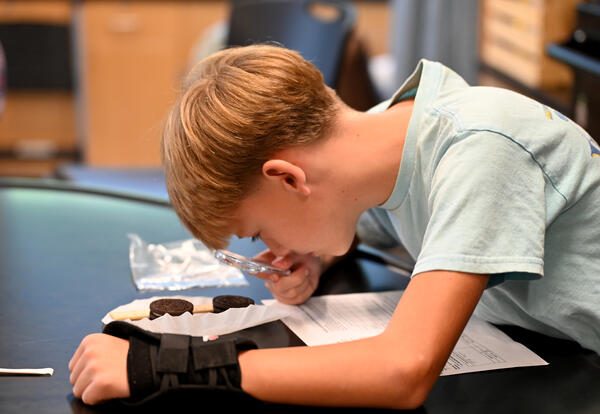
On Thursday, 7th graders in Omini Parks' science class participated in their first lab of the semester as they explored and identified the physical properties of a favorite snack -- Oreos.
Ms. Parks identified the class objective before the lab activity began by writing the academic standard on the dry erase board in a declarative statement: "I can collect and evaluate qualitative data to describe substances using physical properties."
Students watched a video about how Oreo sandwich cookies are made, and then engaged in a question and answer discussion to give observations on the manufacturing process, review various types of physical properties and their scientific terminology, and talk generally about how the lab inquiry would work. The Q&A ended with a predictable question from students... "Will we be able to eat the Oreos?"

The hands-on lab exercise required the 7th grade scientists to observe and record the differences between regular Oreos and the Double Stuff variety based on their physical properties. They followed the instructions in their lab brief to chart a comparison between the two types of cookies by observing properties with their magnifying lenses, measuring the height and diameter of both, and weighing the cookies with and without their filling.
The activity let students put their lessons about physical properties into practice with real objects while also practicing vocabulary and writing skills to record their observations and using math skills from the last school year like taking measurements and calculating averages. Of course, they ended the lab by charting the taste of the cookies as well!

These types of activities allow students to see the science standards they are learning come to life in the real world and engage with the content in new ways. Beyond that, they serve as a foundation for encouraging and growing scientific inquiry. Later in the school year, students will use the scientific method they are learning to complete science projects that require real research and the ability to explain and answer questions about their process and results. At the school-level competitive Science Fair last year, 41 Partnership students earned a place in the 2026 regional Science Fair held at MSU. From there, 14 advanced to the State Science Fair conducted at Northeast Mississippi Community College in April.


